Green Earth
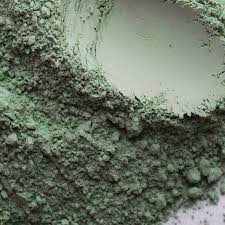
Green earth, also known as terre verte and Verona green, is an inorganic pigment derived from the minerals celadonite and glauconite.[2][3][4] Its chemical formula is K[(Al,Fe3+),(Fe2+,Mg)](AlSi3,Si4)O10(OH)2.[5]
First used by the ancient Romans, green earth has been identified on wall paintings at Pompeii and Dura-Europos.[6][7] The Renaissance painter and writer Cennino Cennini claimed that “the ancients never gilded except with this green” being used as a bole, or undercoating. In the Middle Ages one of its best-known uses was in the underpainting of flesh tones.[5]
Green earths have been rather confusingly referred to as “verda terra” or “terra verde di Verona”, which scholars have assumed incorrectly referred to Veronese green, which is actually an emerald green pigment much used in the 18th century.[8] SEM/EDAXS data have demonstrated that it is possible to discriminate between these two sources of celadonite in Roman wall paintings through the presence of trace elements.[9] Spectroscopically, therefore, the analytical challenge is to differentiate between the green earths celadonite and glauconite, and perhaps chlorite, and the copper-containing malachite and verdigris, with the added ability to recognize the presence of haematite, Egyptian blue, calcite, dolomite, and carbon which have been added to change the colour tones.
High quality deposits can be found in England, France, Cyprus, Germany and at Monte Baldo near Verona in Italy.[7] The color ranges from neutral yellow green to pale greenish gray to dark matte olive green.[5][4]
| Green earth | |
|---|---|
| Green earth pigment | |
| Color coordinates | |
| Hex triplet | #DADD98 |
| sRGBB (r, g, b) | (218, 221, 152) |
| HSV (h, s, v) | (63°, 31%, 87%) |
| CIELChuv (L, C, h) | (86, 48, 88°) |
| Source | Derwent[1] |
| ISCC–NBS descriptor | Light yellow green |
| B: Normalized to [0–255] (byte) | |

Sienna
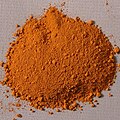
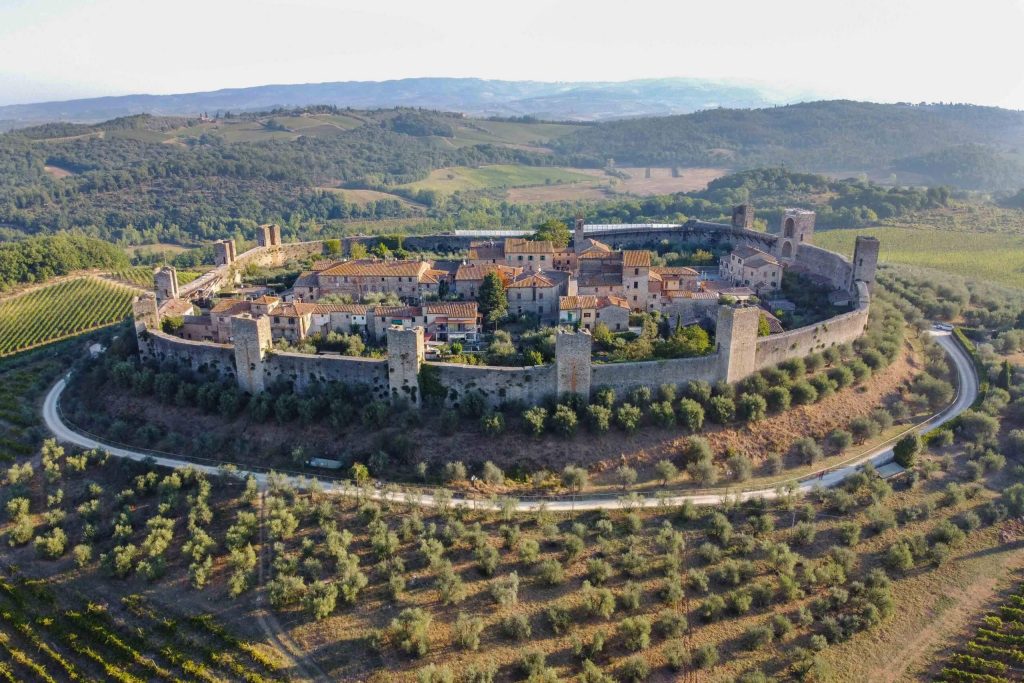
Sienna (from Italian terra di Siena ‘earth of Siena’) is an earth pigment containing iron oxide and manganese oxide. In its natural state, it is yellowish brown, and it is called raw sienna. When heated, it becomes a reddish brown, and it is called burnt sienna.[2] It takes its name from the city-state of Siena, where it was produced during the Renaissance.[3] Along with ochre and umber, it was one of the first pigments to be used by humans, and is found in many cave paintings. Since the Renaissance, it has been one of the brown pigments most widely used by artists.
The first recorded use of sienna as a color name in English was in 1760.[4]
The normalized color coordinates for sienna are identical to kobe, first recorded as a color name in English in 1924.[5]
| Sienna | |
|---|---|
| Color coordinates | |
| Hex triplet | #882D17 |
| sRGBB (r, g, b) | (136, 45, 23) |
| HSV (h, s, v) | (12°, 83%, 53%) |
| CIELChuv (L, C, h) | (32, 73, 18°) |
| Source | [1] |
| ISCC–NBS descriptor | Strong reddish brown |
| B: Normalized to [0–255] (byte) | |
Earth colors
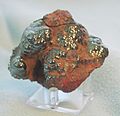
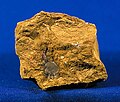
Like the other earth colors, such as yellow ochre and umber, sienna is a clay which is partially composed of iron oxides. In the case of sienna, the most prevalent iron oxides are limonite (which in its natural state has a yellowish color), and goethite. In addition to iron oxides, natural or raw sienna is also composed of manganese oxide, which makes it darker than ochre. Aluminum oxides have also been found in the soil at very low levels.[6] When heated, the limonite and goethite is dehydrated and turns partially to hematite, which gives it a reddish-brown color.[7] Sienna is lighter in shade than raw umber, which is also clay with iron oxide, but which has a significantly higher content of manganese (5 to 20 percent) making it greenish brown or dark brown in color. When heated, raw umber becomes burnt umber, a very dark brown.[8]